


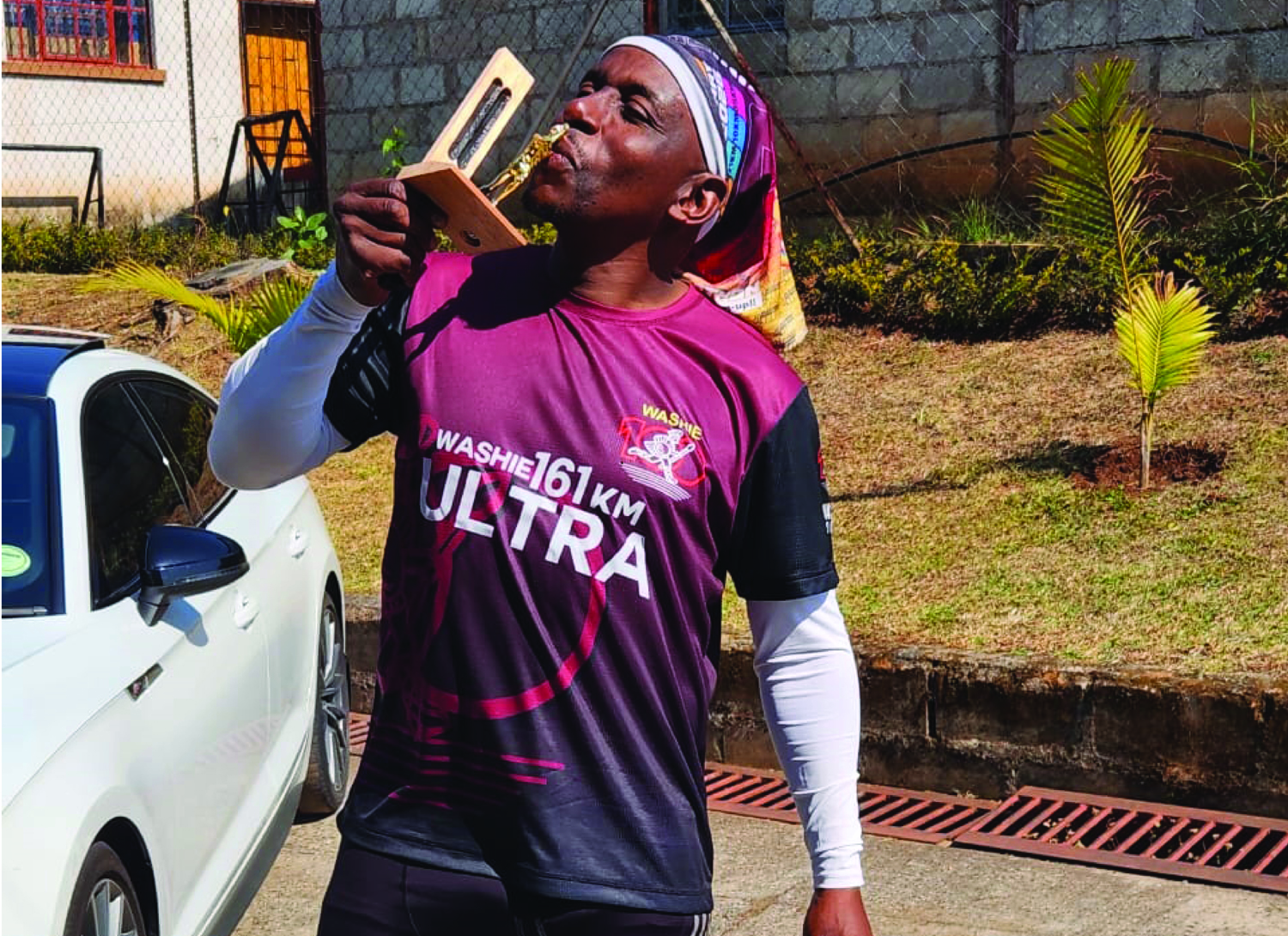
ATHLETICS – Eswatini has a new endurance trailblazer after Andreas Simelane etched his name into the country’s sporting history by becoming the first Liswati to complete the legendary Washie 100 Miler, one of South Africa’s toughest ultramarathons.
Simelane completed the punishing 161-kilometre race, staged from July 31 to August 2 in the Eastern Cape, overcoming one of the world’s most demanding road endurance challenges.
The iconic event gives runners just 26 hours to conquer the relentless point-to-point course, a feat only the mentally and physically strongest athletes achieve.
Speaking exclusively to the Eswatini Observer sports desk, Simelane described the historic achievement as the culmination of more than a decade of discipline, consistency and an unwavering desire to push beyond his perceived limits.
“I am proud to be the first Liswati and honestly very humbled to have achieved this feat. This would not have been possible without the support I have received from family, friends and the running community as well,” he said.
For Simelane, the journey to becoming a history-maker began in the most modest fashion.
He first laced up his running shoes in 2015, covering just 2km with the simple goal of improving his physical fitness.
What started as a recreational activity soon evolved into a passion that transformed his outlook on life.
“I started running in 2015. I started off with 2km, but through consistency the distance increased because your body adjusts only if you are consistent in what you are doing,” he explained.
His breakthrough into long-distance running came when he entered the Imbube Marathon, his first full marathon.
Crossing that finish line opened the door to the demanding world of ultramarathons, where every race exceeds the traditional marathon distance of 42.2km.
Since then, Simelane has steadily raised the bar. Last December, he completed a solo 106km run from Mhlume to Manzini, covering the distance in 12 hours, 54 minutes and four seconds as part of his preparation for bigger endurance challenges.

He also boasts five finishes in the Comrades Marathon, Africa’s most famous ultra-distance race. Rather than being satisfied with conquering the Comrades, Simelane sought an even greater challenge.
“I had done the Comrades five times and I wanted to challenge myself. Can I go beyond the Comrades distance? The answer was yes because I had already done 106 kilometres and 115 kilometres before attempting the 100 Miler.”
The achievement, he says, was built more on mental strength than physical ability.
“In life, you have to compete against yourself, not against anyone. Try to be better than what you were yesterday because if you compete with someone else, you do not know the resources or support they have.
“I wanted to see what would break or fail. If other people can run these races, why can’t I? They are ordinary people just like me.”
That philosophy carried him through the countless hours of pain and fatigue that define ultra-marathon running.
“Our slogan is, Finish what we have started. You just have to soldier on. That mindset translates into your daily life.”
The Washie 100 Miler is South Africa’s oldest and most iconic 100-mile road race. Established in 1977 by Lionel Whitfield in honour of his father, Granville Washington ‘Washie’ Whitfield, the race has earned a fearsome reputation as one of the ultimate tests of human endurance.
Runners battle through 161km of unforgiving tar roads under strict time limits, making simply reaching the finish line a victory in itself.
For Simelane, becoming the first Liswati to conquer the legendary race is more than a personal milestone. It is proof that with consistency, resilience and self-belief, athletes from the kingdom can stand alongside the world’s toughest endurance runners and achieve what once seemed impossible.
‘MY BRAIN SWITCHED OFF AFTER 100KM’
ATHLETICS – While completing 161km may seem like an extraordinary physical feat, Andreas Simelane says the greatest battle during the gruelling Washie 100 Miler was fought in the mind.
The history-making runner revealed that after surpassing the familiar 90km distance of the Comrades Marathon, his body entered uncharted territory where instinct took over after his brain could no longer process the relentless challenge.
Simelane said his mind began questioning the seemingly endless race shortly after reaching the Comrades distance.
“The body is used to the Comrades distance of about 90km. After that, the brain started asking, ‘When is this thing finishing?’ There was no answer,” he recalled.
He said the mental struggle intensified until he reached the 100km mark, where something remarkable happened.
“After 100km, the brain just shut down. My heartbeat, which is normally around 147 beats per minute when I am running, dropped to about 131 and even 128. From there it was like the body was on autopilot.”
Simelane described the final 61km as an almost surreal experience.
“At some stage, you really do not know what you are doing, but your muscles keep lifting your legs and they keep moving. The body just carries on.”
The race began at 5pm on Friday and demanded that runners continue through the darkness, into Saturday morning, across the entire day and towards dusk again before reaching the finish line.
“It was my first time running through an entire night. You start at 5pm on Friday, run through the night, through Saturday morning, then the whole day until around 6pm on Saturday.”
Simelane crossed the finish line in 25 hours, nine minutes and 41 seconds, comfortably inside the event’s demanding 26-hour cutoff.
Despite spending more than a full day on his feet, stopping was never an option.
“You cannot stop because once you do, you lose balance. The body gets used to being in motion, almost like a bicycle. If you need to drink or eat something, you keep walking. You cannot afford to stand still for long because your muscles begin to tighten.”
Reflecting on the experience afterwards, Simelane summed up the remarkable journey in a social media post that captured the sheer brutality of the race.
“At the Comrades 90km mark, the brain started asking, ‘When is this crazy run finishing?’ There was no clear answer. It remained patient for another 10km before finally switching off completely at the 100km mark.
“The heart took charge while the lungs, kidneys, pancreas and muscles were on their own. In the absence of the captain, the body switched to cruise mode for the last 61.09km. ‘Mission accomplished.’”